
FIRE AT THE CATHEDRAL CHURCH OF ST. JOHN THE DIVINE
On April 14, 2019, a fire broke out in a historical art storage crypt in the basement of the Cathedral of Saint John the Divine. Though the fire was quickly extinguished, billowing smoke spared no surface in the church from soot and odor contamination. Church officials were distraught. They needed the church operational for Easter and completely restored by Christmas. The cathedral is one of the largest in the world at 120,000 square feet and with 125-foot ceilings — a daunting place to clean.
CLEANING A SANCTUARY
La collaboration de l'assureur avec FIRST ONSITE a permis de commencer immédiatement les travaux de restauration, selon une stratégie en trois phases. La première phase a consisté à isoler la zone de l'incendie et à nettoyer tout ce que les paroissiens pourraient toucher. Une équipe de 80 a travaillé sans relâche, enlevant la suie et désodorisant les murs, les planchers et des centaines de sièges. Les bancs d'église anciens, d'une valeur inestimable, et d'autres objets nécessitaient une attention particulière. Grâce au travail de l'équipe, l'église était utilisable dès le Jeudi saint, soit trois jours plus tôt que prévu.
RESTORING A HISTORIC LANDMARK
The next step focused on restoring the basement and removing the overwhelming smoke smell. The fire-damaged space was used as a studio and storage for hundreds of artifacts and antiques. Valuable items were removed, and the rest cleaned and stored off-site. An exhaust system was set up to remove smoke odor. The team next worked tirelessly to clean and sanitize a pre-school classroom, allowing classes to resume 24 hours later.
The real challenge was in cleaning the basement architecture, made of granite and fragile tile, above a rocky, uneven floor. An amphitheater, chapels, and the tombs of two bishops also occupied the space. FIRST ONSITE worked with an engineering firm, historic conservator, and cathedral staff to devise a plan. They filled the floor with gravel, leveled it, and lay down plywood, allowing them to safely build 60-foot scaffolds to reach the basement’s arches and stained-glass windows. Surfactants and degreaser, soot sponges, and HEPA vacuuming were used to restore and protect the original building materials. Three months later, FIRST ONSITE had completely restored the basement without damage.
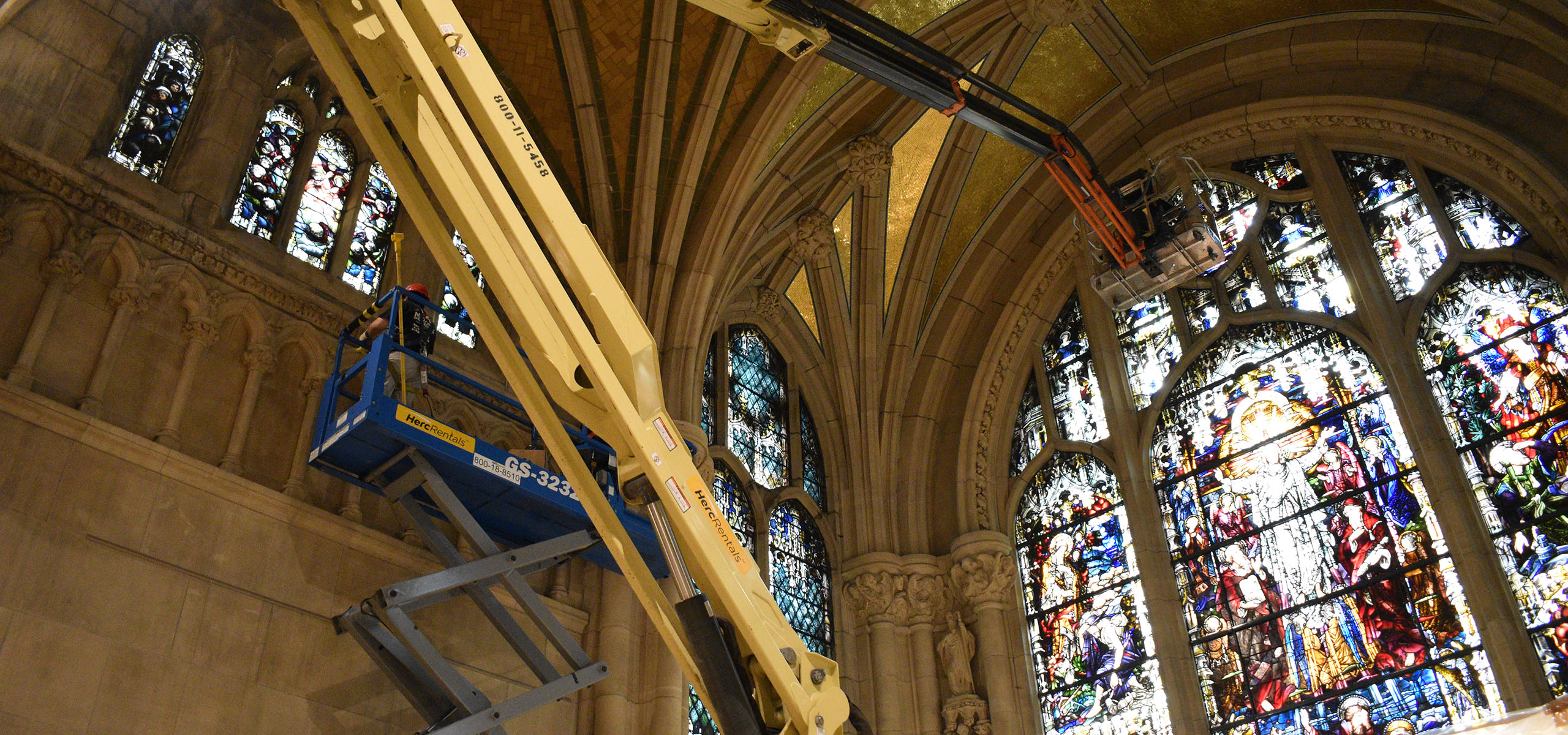
With only five months until Christmas, FIRST ONSITE moved to the third phase: cleaning, de-odorizing, and restoring the church interior, including the altar, gilded fixtures, a massive pipe organ, and one of the biggest stained-glass windows in the world. A free-standing, 18-level scaffold was painstakingly constructed above the altar and around priceless fixtures to access the 125-foot ceilings, a process that took 13 weeks. The lead in the windows and in the pipe organ was cause for concern, but the team was able to restore both without contamination. In fact, over eight months and almost 25,000 working hours, no injuries or illnesses were reported.
A CATHEDRAL RESTORED
Au total, 40 zones ont été restaurées, incluant des cryptes, des sacristies, des autels en bois anciens, des espaces de rangement, des escaliers en colimaçon en pierre, des bureaux des installations, un grenier, une boutique de souvenirs, une galerie d’art et un système complexe de chauffage, ventilation et climatisation (CVC), tout en continuant à tenir les services. Le projet a nécessité une coordination avec la ville, les conservateurs, les ingénieurs et les assureurs. Grâce à des rapports quotidiens sur le terrain et à des réunions hebdomadaires, l'équipe de restauration a tenu les parties prenantes informées.
FIRST ONSITE finished the job a week before Christmas and $1 million under budget. While at times the challenges seemed insurmountable, the crew stayed grounded by thinking about the church community. A community they now felt part of.
Partager ceci :


 BOLT™ Connexion